The outbreak briefing that reaches you before the patient does.
The team behind Force of Infection, trusted by 47,000 readers for flu, Covid-19, RSV, and norovirus tracking, is proud to announce FOI Clinical, a subscription resource for clinicians.
What you get: A weekly outbreak briefing plus real-time health alerts for fast-moving events. Learn more about what to expect.
Pricing: $189/year or $18/month. 7 day free trial on signup. Group and institutional rates available.
Welcome to the thirty-sixth edition of FOI Clinical. Each week, we'll send you a briefing on outbreak news. When something urgent breaks, you'll get an alert the same day.
In this edition
Measles: a sixth death in Pennsylvania – Influenza: early-season activity – National surveillance, week 39 – Baylisascariasis: a fatal pediatric case in Los Angeles County – Powassan virus: a New York case, and a national count already at 46 – Dengue: Florida reaches 296, and Hillsborough extends its emergency – Ebola: a second case in Kenya, and a first vaccine trial – Russia: WHO’s assessment of the Irkutsk death
National interest
Measles: a sixth death in Pennsylvania
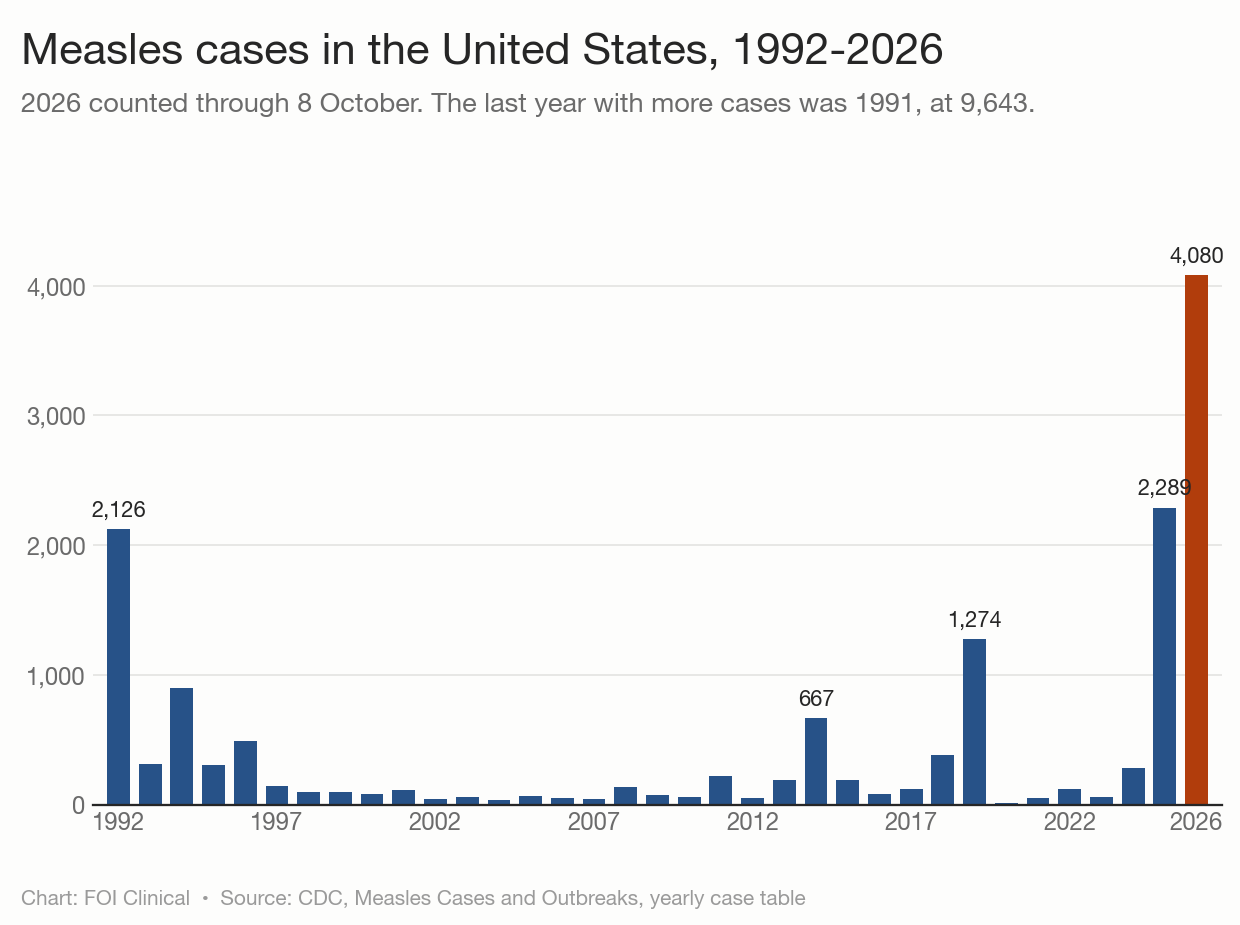
CDC's measles page, updated October 9, reports 4,080 confirmed cases. CDC's yearly incidence table shows this is the worst year since 1991, when 9,643 cases were reported. The 2025 total was 2,289. The chart below starts the following year, 1992, when 2,126 cases were reported.
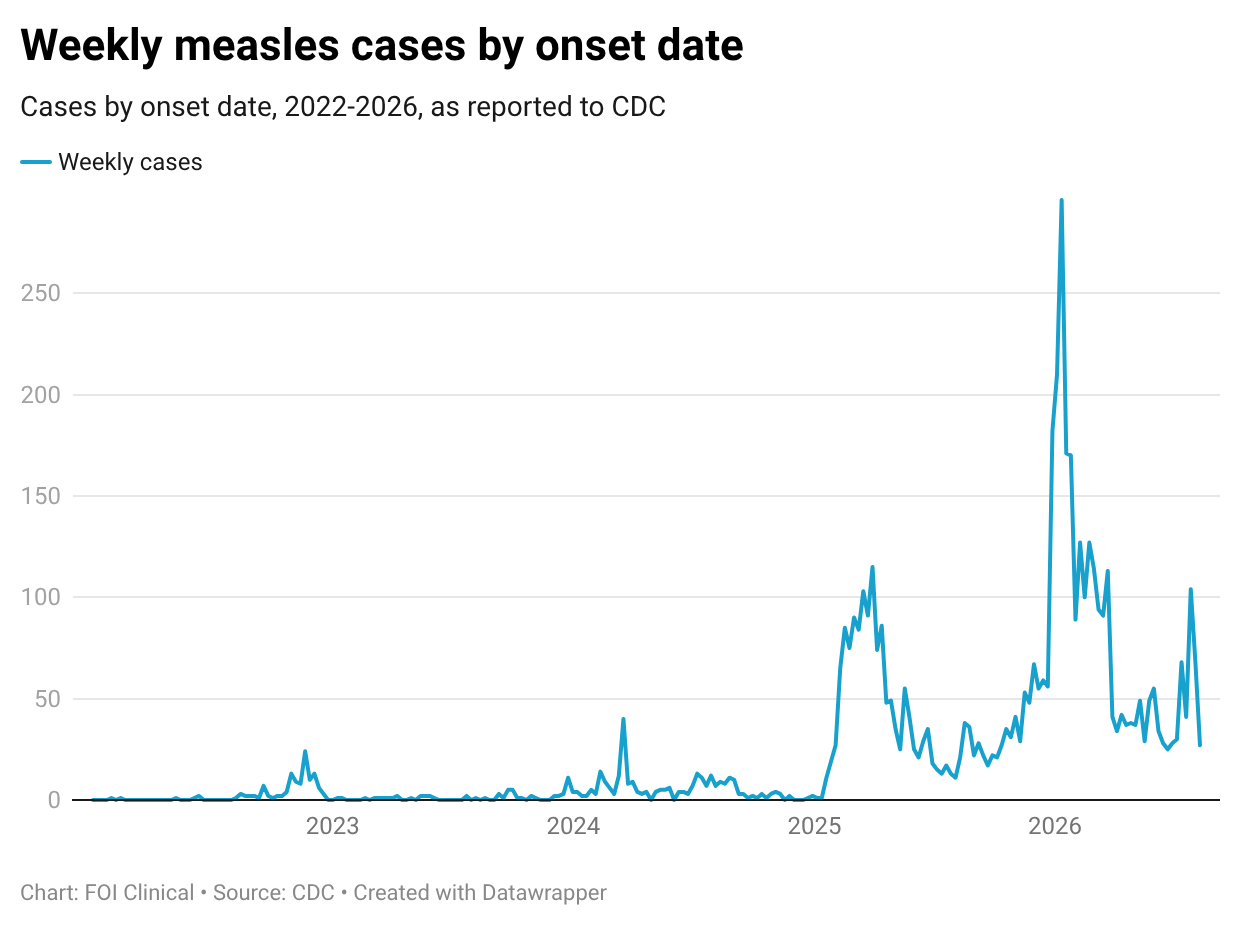
There have been 42 outbreaks this year, 96% of cases are outbreak-associated (3,897 of 4,080), and 10% of patients have been hospitalized (414 of 4,080). CDC's national death count still says two.
The regional picture is worse. On October 9 the Pan American Health Organization rated the risk of measles spread in the Americas as very high, in part because of religious mass gatherings in South America that are expected to increase travel. The region reported 55,792 confirmed cases and 77 deaths in 17 countries and territories between January 4 and October 3, 4.8 times the same period last year. Guatemala, Mexico, the United States, Peru and Canada accounted for 99.5% of them.
In other news, Pennsylvania has reported a sixth measles-associated death in a 39 year old woman. According to the Franklin County Coroner, she had underlying health conditions. In an interview with NBC News, pediatrician and vaccine expert Dr. Paul Offit estimated that the state could have “closer to 6,000 cases,” based on the number of reported deaths.
State updates:
Pennsylvania: the state's measles dashboard showed 1,222 cases on October 14, including 157 in the preceding seven days. Cases have been reported in 42 counties, with Lancaster and Mifflin counties most affected. To date, 225 people have been hospitalized, just under a fifth of all cases, and 34% of cases are in people under 18.
Wisconsin: state health services confirmed 267 cases statewide on October 13. The southwest outbreak in Grant, Iowa, Lafayette and Vernon counties accounts for 237 confirmed and six probable. A new cluster has appeared in Rock County: five probable cases, linked to one another but not to the southwest outbreak, with the source unknown and laboratory confirmation still pending. Marathon County has six cases and Chippewa 11, both attributed to out-of-state travel.
Influenza: early season activity
CDC's FluView for week 39, published October 9, says seasonal influenza activity is increasing in many parts of the country but remains low overall. Early-season activity is higher than typically observed at this time of year. Clinical laboratory positivity rose to 3.6%; 1,435 positives from 39,317 specimens. The highest activity is on the West Coast, particularly in HHS Region 9, where test positivity is nearing 10%.
Of 127 influenza A specimens subtyped at public health laboratories in week 39, nearly all (125) were H1N1pdm09. Since week 21, 80.5% of influenza A viruses reported have been H1N1pdm09, most of them the D.3.1.1 HA subclade. Week 39 also ends the 2025–26 surveillance season; the 2026–27 season began on October 4.
Welcome to the thirty-fifth edition of FOI Clinical. Each week, we'll send you a briefing on outbreak news. When something urgent breaks, you'll get an alert the same day.
In this edition
Measles: Pennsylvania passes 1,000, New York declares an emergency – Influenza: CDC says activity is increasing – Cyclosporiasis: FDA closes with a finding – Mumps: San Diego State reaches 15 – National surveillance, week 38 – Vibrio vulnificus: Florida – Dengue: Florida passes 250 – Cryptosporidiosis: a hotel pool in Washington – Russia: a death at a plague institute – Ebola: an imported death in Kenya
National interest
Measles: Pennsylvania passes 1,000 cases and records a fifth death
On September 30, the Pennsylvania health department confirmed a fifth measles-associated death in an unvaccinated resident of Lancaster County. The department said it reported the death to CDC and would not release identifying details.
CDC's national count, updated October 2, still lists two measles deaths in 2026. The mechanism behind the discrepancy is the one we have described since Issue 32: CDC draws its figure from National Center for Health Statistics death records instead of state reports, and those records are filed and coded over months.
State updates:
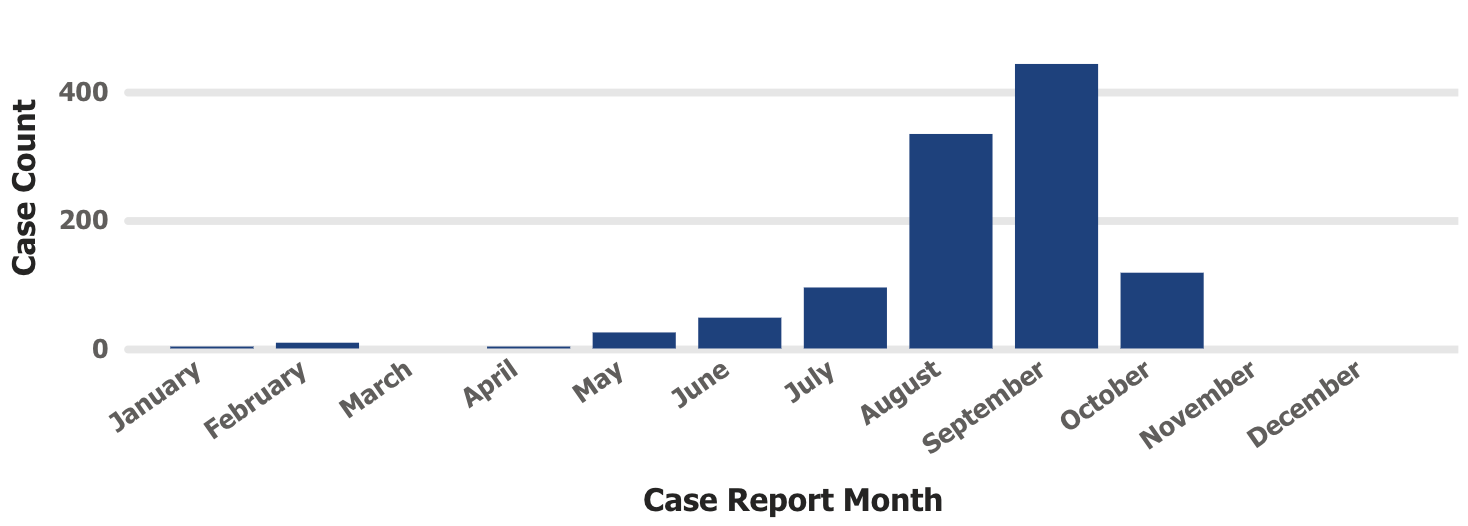
Pennsylvania: the state dashboard read 1,078 cases on October 7, including 145 in the preceding seven days. To date, 207 people have been hospitalized, just under a fifth of all cases, and fewer than 1% of cases were in people recorded as fully vaccinated. The health department's September 30 news release reports that providers, who typically give about 25,000 MMR doses a month, gave more than 49,000 in August and more than 53,000 in September; state health center staff have given more than 5,500 doses at 180 pop-up clinics since the outbreak began in late April. Increased immunization coverage is important for slowing the spread of the months-long outbreak; September saw the most cases so far this year.
Wisconsin: state health services confirmed 258 cases statewide on October 6, up from 214 a week earlier. The southwest outbreak in Grant, Iowa, Lafayette and Vernon counties accounts for 234 confirmed and six probable. Marathon County has five cases and Chippewa 11, both of which the department attributes to out-of-state travel.
New York: Governor Hochul declared a state disaster emergency on October 5 in response to an increasing number of cases in the state and in neighboring Pennsylvania. The executive order lets paramedics, advanced EMS providers, pharmacists and midwives administer measles vaccines, and allows nurses as well as physicians to order testing. The state reports 108 cases this year as of October 3, seven in New York City and 101 elsewhere in the state. Ninety-two have been reported since July 15, among under-immunized, rural communities in 18 counties, and local health departments have given more than 1,000 MMR doses across rural areas since then.
Influenza: CDC now says activity is increasing
CDC updated its assessment to recognize early-season flu activity. Where FluView for week 37 opened with "seasonal influenza activity is low," week 38, published October 2, reads "seasonal influenza activity remains low nationally, but is increasing."
Clinical laboratory test positivity rose to 3.4%, from 2.7% the week before; 1,151 positives from 33,547 specimens, 96% of them influenza A. Outpatient visits for influenza-like illness (ILI) were 1.7% nationwide, which is below the 3.1% baseline that marks the start of a flu season, so by the outpatient measure the season has not started, even as test positivity climbs. Outpatient ILI is highest in children under five, at 5.5%, up from a recent low of 3.2%.
The regional picture reveals increased activity in many Western states. Our Outbreak Outlook for October 4 puts HHS Region 9 (which includes California, Arizona, Hawaii and Nevada) at 7.1% test positivity, up from 3.4% two weeks earlier. Region 10, covering Alaska, Idaho, Oregon and Washington, is at 6.0%, slightly down from 6.5% the week before. Both regions show low but rapidly increasing emergency department visits for influenza, particularly in children.
Of 55 specimens subtyped at public health laboratories in week 38, 53 (96.4%) were A(H1N1)pdm09 and just two were H3N2. Last year, H3N2 predominated. The weekly numbers are still too small to call a change in dominant subtype, but the direction has now been consistent for two weeks.
Welcome to the thirty-fourth edition of FOI Clinical. Each week, we'll send you a briefing on outbreak news. When something urgent breaks, you'll get an alert the same day.
In this edition
Influenza: an early signal in the Pacific states – Measles: CDC's count reaches two deaths – Hepatitis A: imported frozen clams – E. coli: raw-milk cheese – Candida endophthalmitis after cataract surgery – Covid-19 – National surveillance, week 37 – Dengue: three Florida counties declare emergencies – Flea-borne typhus: Los Angeles – Ebola: DRC
National interest
Influenza — an early signal in the Pacific states
Influenza is off to an early start in Pacific states. Already, test positivity in the Pacific census division is at 6.9% and rising quickly. Other regions of the country are not seeing much activity yet; the Mountain division is next highest at 3.0% test positivity. Other regions are all below 2%: 1.4% in New England, 1.6% in the Mid-Atlantic and under 1% in the South Atlantic.
State by state: Alaska's influenza A positivity has climbed for several weeks and is now similar to levels recorded last December, with emergency department visits for influenza at 1.8%. Washington is at 8.4% in CDC data, with ED visits at 0.9% against the state's own activity threshold of 1.4%, and children under five are most affected. Hawaii is at 6.3%, with ED visits up from 1% to 1.4%. California reads 5% on the state dashboard and 8.5% in CDC clinical laboratory data, with the Bay Area at 7%. Oregon’s activity is somewhat lower than its neighbors but still elevated compared to the off season.
So far, H1N1 is predominating. Nationally, 96 specimens were subtyped at public health laboratories in week 37. Of those, 91 were A(H1N1)pdm09 and five were H3N2. This is a change from last winter, when H3N2 was most common. Ninety-six specimens is too few to establish a change in the dominant subtype, but it’s notable given the early season.
Clinical note: Consider encouraging patients to get vaccinated as soon as possible, rather than waiting until later in the season, particularly in the Western region. CDC recommends everyone six months and older should be vaccinated annually, ideally by the end of October, and vaccination should continue as long as flu is circulating.
CDC's measles page, updated September 25, now lists two measles deaths in 2026. It listed one a week ago and none the week before that. The 2025 column still shows three deaths. Separately, Pennsylvania has confirmed five measles-associated death, an increase of one since last week.
State updates:
Pennsylvania: the state dashboard reported 943 cases on September 30, including 119 in the preceding seven days; 176 people have been hospitalized. In its September 25 statewide update, the health department put the count at 890 across 39 counties, with four deaths and four cases in vaccinated people. State health staff have given more than 5,300 MMR doses at 165 pop-up clinics since the outbreak began in late April.
Wisconsin: state health services confirmed 214 cases statewide as of September 29, up from 171 a week earlier. The southwest outbreak in Grant, Iowa, Lafayette and Vernon counties account for 202 confirmed and six probable. Marathon County now has three cases and Chippewa one, all linked to out-of-state travel and not to the southwest outbreak.
Illinois: the state reported 23 confirmed cases this year on September 25, 16 of them in an outbreak in Douglas and Moultrie counties among people unvaccinated or of unknown vaccination status. Separate cases in Kane and Madison counties are not outbreak-linked.
Hepatitis A — imported frozen clams, and an unusual hospitalization rate
Welcome to the thirty-third edition of FOI Clinical. Each week, we'll send you a briefing on outbreak news. When something urgent breaks, you'll get an alert the same day.
In this edition
Measles: deaths reported – West Nile virus: California at a five-year high – Salmonella: pet turtles – Cyclosporiasis: weekly updates end – Seasonal illnesses – Dengue: Florida confirms a death – Legionnaires' disease: South Bronx – Mumps: San Diego State – Ebola: DRC
National interest
Measles: CDC records one death, Pennsylvania four
CDC's measles page, updated September 18, now lists one measles death in 2026. Last week, it listed none. The 2025 column still shows three.
The number shows an asterisk, which corresponds to a note that says the death count is subject to change as additional information becomes available and relevant reviews are completed. CDC also says it is working with the Council of State and Territorial Epidemiologists on a standardized case definition for measles deaths, intended to make classification consistent across jurisdictions. The single death is at odds with state-level tallies. Pennsylvania has reported four measles-associated deaths.
As we reported last week, CDC shifted the source of its death count from state reports submitted through the National Notifiable Diseases Surveillance System to death records held by the National Center for Health Statistics, which are filed and coded months after the event.
State updates:
Pennsylvania: the state dashboard reports 835 cases as of September 23, including 111 in the preceding seven days. In all, 164 people have been hospitalized. Fewer than 1% of cases were in people recorded as fully vaccinated. The four deaths announced through September 15 are included on the dashboard.
Wisconsin: state health services confirmed 171 cases statewide as of September 22. The southwest outbreak, in Grant, Iowa, Lafayette and Vernon counties, accounts for 161 confirmed and six probable cases as of September 18. Two other cases, in Marathon and Chippewa counties, are linked to out-of-state travel and are not connected to the southwest outbreak.
Georgia: unchanged from last week at 16 cases this year, including ten linked to a metro Atlanta daycare.
Utah: The state has reported 527 cases year to date, including three in the last three weeks. Last year, there were 197 cases reported in the state.
West Nile virus: California at a five-year high
CDC's ArboNET data, as of September 22, reported 813 West Nile virus disease cases in 43 states, of which 607 (75%) were neuroinvasive.
California accounts for a large share. The state's surveillance dashboard, updated September 18, records 147 human cases across 21 counties, 25 of them reported in the preceding week. Also reported are 623 WNV-positive dead birds, 3,544 positive mosquito samples, 141 sentinel chickens and 14 horses. The California Department of Public Health described activity as the highest in five years in a news release from August 20, when the state had recorded 30 cases from 13 counties.
Welcome to the thirty-second edition of FOI Clinical. Each week, we'll send you a briefing on outbreak news. When something urgent breaks, you'll get an alert the same day.
Measles: four deaths in Pennsylvania – Rabies: CDC advisory on post-exposure prophylaxis – Cyclosporiasis season updates – Salmonella: broccoli sprouts – Seasonal respiratory viruses – Dengue: Florida – Legionnaires’ disease: South Bronx – Eastern equine encephalitis in Michigan and Wisconsin – Ebola: DRC
National interest
Measles: four deaths in Pennsylvania, none in the national count
Pennsylvania has now confirmed four measles-associated deaths in 2026. CDC’s national count still lists none.
The Pennsylvania Department of Health announced two more measles-associated deaths on September 15, in addition to the two deaths in Lancaster County infants that were reported on August 25. All four were unvaccinated, and neither infant was old enough for immunization. The state says it confirmed each through investigation with the relevant county coroner’s offices by assessing clinical evidence of infection, laboratory testing, and exclusion of unrelated causes.
The four deaths:
A male neonate in Lancaster County, born August 14 to a mother with active measles. The infant died shortly after delivery. Measles virus was detected in postmortem lung tissue. The immediate cause of death was splenic rupture.
A six-week-old infant in Lancaster County who died August 18. The infant had Amish lethal microcephaly and was receiving palliative care; the coroner subsequently concluded measles was the cause of death.
A 40-year-old woman in Jefferson County who died September 12. She lived with chronic obstructive pulmonary disease and asthma and was dependent on supplemental oxygen. She declined testing while alive; a nasal swab taken at death returned positive. Her husband had symptoms consistent with measles but was never tested, and has recovered.
An 18-year-old in Mifflin County, whose cause of death was determined to be acute disseminated encephalomyelitis (ADEM). ADEM is a rare post-infectious inflammatory attack on the myelin of the brain and spinal cord, occurring days to weeks after measles in roughly 1 in 1,000 cases.
Why federal and state reporting disagree
CDC has changed the data source it uses to count measles deaths, moving from state reports submitted through the National Notifiable Diseases Surveillance System to death records held by the National Center for Health Statistics. The agency’s measles page, updated September 11, states that the National Center for Health Statistics "does not currently have any death records from 2026 that indicate measles is the underlying cause." The 2026 death count is shown as an asterisk; the 2025 column shows three.
"CDC will report measles deaths if and when the National Center for Health Statistics reports measles as the underlying cause of death," a Department of Health and Human Services spokesperson told The Guardian.
Epidemiologists quoted by CIDRAP called the change confusing, noting that vital statistics are designed to track long-term mortality trends rather than individual infectious disease cases. Death certificates are filed, coded and released on a timescale of months. Pennsylvania has submitted its measles-associated death case definition to CDC and the Council of State and Territorial Epidemiologists, which are developing a standardized national definition.
CDC reported 3,294 confirmed cases nationally as of September 10, with 38 outbreaks this year and 95% of cases outbreak-associated (3,123 of 3,294).
State updates
Pennsylvania: The state has reported 693 cases as of September 14, including 99 new cases in one week, across 38 counties. Of the cases, 133 have been hospitalized and fewer than 1% were in people recorded as fully vaccinated. The dashboard still lists two deaths; the two announced on September 15 will likely be added to the tally at the next update.
Wisconsin: The state has reported 163 cases as of September 11, of which 162 were unvaccinated. The outbreak is concentrated in Lafayette, Iowa and Grant counties, and measles virus has now been detected in wastewater from treatment facilities in all three.
Georgia: The state has confirmed 16 cases this year as of September 11, including a cluster of ten linked to a metro Atlanta daycare.
Rabies: CDC warns on post-exposure prophylaxis as exposures rise
CDC issued a Health Alert Network (HAN) advisory on September 10 warning of an increase in human rabies exposures and errors in administering post-exposure prophylaxis.
Welcome to the thirty-first edition of FOI Clinical. Each week, we'll send you a briefing on outbreak news. When something urgent breaks, you'll get an alert the same day.
In this edition
Measles – Cyclosporiasis – Sprouts recall expanded – Covid-19 – National surveillance, week 34 – West Nile virus – Ebola: DRC
National interest
Measles — U.S. tops 3,000 cases
CDC reported 3,134 confirmed cases on September 3, up 231 cases in one week. There have been 38 outbreaks this year, 95% of cases are outbreak-associated (2,969 of 3,134), and 8% of cases (248 of 3,134) have been hospitalized. The last year with more measles cases than 2026 was 1991, when 9,643 were reported; 1992 saw 2,126 cases, and no year since has come close until now. Active outbreaks are running concurrently in at least four states.
CDC has changed its stated reason for leaving Pennsylvania's two measles-associated deaths out of the national tally. Last week's footnote said the agency was reviewing the circumstances and causes of death. The current footnote says the National Center for Health Statistics "does not currently have any death records from 2026 that indicate measles is the underlying cause," and that CDC is working with the Council of State and Territorial Epidemiologists "to develop a standardized case definition for deaths due to measles." U.S. deaths for 2026 remain listed as an asterisk rather than a number; the 2025 column still shows three.
State updates:
Pennsylvania: The state has reported 624 cases as of September 9, including 91 new cases in one week. 109 people have been hospitalized, up from 87 two weeks ago; 32% of cases are under 18, and no cases were in people recorded as fully vaccinated. The dashboard continues to list two measles-associated deaths.
Wisconsin: The state has reported 151 confirmed and six probable cases in an outbreak across Grant, Iowa and Lafayette counties as of September 8, the state's highest annual count since 1990. The outbreak roughly doubled in the last week of August and has grown by about half again since. Wisconsin's kindergarten two-dose MMR coverage was 85.1% in 2025-2026, nearly ten points below the herd-immunity threshold of 95%. The state department of health also reports that wastewater samples from treatment facilities in Lafayette and Iowa counties during the week of August 24 were positive for measles virus. A Grant County sample from August 26 was negative on retest and has been withdrawn, though a sample from August 19 was positive.
Texas: The state has reported 191 cases as of September 4, unchanged in a week, with 136 in Hudspeth County. The state department of health notes that some confirmed cases are among people housed in federal detention facilities.
Cyclosporiasis — season closed, cases still accruing
Welcome to the thirtieth edition of FOI Clinical. Each week, we'll send you a briefing on outbreak news. When something urgent breaks, you'll get an alert the same day.
In this edition
Measles – Cyclosporiasis: season totals – National surveillance, week 33 – Naegleria fowleri: North Carolina and Louisiana – Chikungunya: Florida – Ebola: DRC past 6,000
National interest
Measles
CDC reported 2,903 confirmed cases on August 27, up 126 in one week. There have been 37 outbreaks this year, 94% of cases are outbreak-associated, and 8% of cases (223 of 2,903) have been hospitalized.
Measles is back in the national headlines this week, as the first two deaths in 2026 spark controversy. One of the two deaths was a newborn. CIDRAP reports that the infant died of a lacerated spleen, and that the dispute is over whether congenital measles infection played a role. Lancaster County Coroner Stephen Diamantoni told media outlet WGAL that his office's forensic pathologist found the spleen "neither enlarged nor inflamed," and that many types of force can lacerate a spleen; his investigation is continuing. State Health Secretary Debra Bogen said she had thoroughly reviewed the case investigation information, and Governor Josh Shapiro has said the baby would not have died had the mother been vaccinated. There are no public details about the second death.
CDC's measles page, updated August 30, now lists U.S. measles deaths for 2026 as an asterisk rather than a number. The agency said that "available information does not establish whether measles caused or contributed to the deaths or whether the individuals died from other causes while infected with measles," and that it "will update the national count as additional information becomes available." The decision to include this language instead of recording two measles-associated deaths came from CDC director Erica Schwartz, according to reporting from CNN. Pennsylvania state public health officials have decried the decision to overrule submitted data.
Paul Offit of Children's Hospital of Philadelphia wrote in his newsletter that splenic rupture is “extremely rare” in neonates, and difficult to assess post-mortem. He listed CMV, rubella, hemolytic disorders, and inborn errors of metabolism as alternative explanations for a fragile neonatal spleen, and said that absent one of those, the only obvious cause left would be measles.
State updates:
Pennsylvania: The state has reported 540 cases as of September 2, including 119 new cases in one week. 91 people have been hospitalized, 30% of cases are under 18, and 0% of cases were in people recorded as fully vaccinated. The dashboard continues to list two measles-associated deaths. The outbreak reached two new Western Pennsylvania counties, Butler and Westmoreland, with one case each. Schools across the state returned to session in late August.
Utah: The state has reported 518 cases this year and 715 across the outbreak since 2025, but no Utah resident has been diagnosed in the last three weeks as of September 1. This marks a third consecutive week with no new cases.
Texas: The state has reported 191 cases as of August 28, with 136 in Hudspeth County (71% of the state total). DSHS notes a subset of confirmed cases are among people housed in federal detention facilities.
Georgia: Four cases linked to an Atlanta-area daycare, all in children who were unvaccinated or had not completed the MMR series. The state has reported 13 cases so far this year.
Maryland: The state is responding to an outbreak among unvaccinated people in Carroll, Cecil, and St. Mary's counties, with no evidence of widespread community transmission as of August 27.
Cyclosporiasis: season totals
The typical peak season for cyclosporiasis extends from May 1 to August 31. CDC's case data, updated September 1, records 18,445 laboratory-confirmed domestically acquired cases, 990 hospitalisations, and two deaths across 49 states and the District of Columbia. During the same period last year, 1,180 cases were reported. The median age of cases was 46 years, with a range from 1 to 99; 57% of cases are female; and the median symptom onset was July 8.
Welcome to the twenty-ninth edition of FOI Clinical. Each week, we'll send you a briefing on outbreak news. When something urgent breaks, you'll get an alert the same day.
On August 25, the Pennsylvania Department of Health confirmed two measles-associated deaths in unvaccinated residents of Lancaster County. These are the first measles deaths in Pennsylvania in 35 years and the first in the United States this year. The department said it would not release further details, citing patient privacy.
Pennsylvania -424 cases year to date across 30 counties, 197 in Lancaster County. Lancaster kindergarten two-dose MMR coverage is low at 87.6%, compared to 92.7% statewide. Lancaster's coverage is down from 88.5% last year. Roughly 35,000 Pennsylvanians were vaccinated in July, about 10,000 above the usual monthly pace.
Ohio - 109 cases year to date, including 95 indigenous to the state.
Texas - 190 cases year to date, mostly in Hudspeth County. The state notes that some of those cases were in people held in detention.
Utah - 518 cases year to date. Weekly case counts have declined markedly since spring, but a handful of new cases are still reported each week.
Maryland - 31 cases reported year to date. The state health department notes that there is an outbreak in unvaccinated people in Carroll, Cecil, and St. Mary's counties.
Pennsylvania Governor Josh Shapiro declined an offer of federal assistance from HHS Secretary Robert F. Kennedy Jr. Looking ahead, the Pan American Health Organization will review U.S. elimination status in November; Canada lost its status last year after a similar review. The United States achieved elimination in 2000.
E. coli and Salmonella: alfalfa sprouts
The FDA and CDC are investigating 55 illnesses across 15 states linked to alfalfa sprouts from Everything Sprouts, LLC of Minneapolis.
Forty-six people were infected with Shiga toxin-producing E. coli, seven with Salmonella, and two with both. Four of the 48 cases with information available were hospitalized. No deaths have been reported. Illness onset dates range from May 31 to August 8.
Welcome to the twenty-eighth edition of FOI Clinical. Each week, we'll send you a briefing on outbreak news. When something urgent breaks, you'll get an alert the same day.
In This Issue
Measles - Cyclosporiasis and other foodborne illnesses - Covid-19 - West Nile virus - Powassan in Northern states - Dengue in Southern states - Ebola in the Democratic Republic of Congo
National interest
Measles
Measles continues to exceed recent records with 2,566 confirmed cases so far this year, exceeding last year’s total of 2,289. States with currently active clusters include Pennsylvania (55 reported to the National Notifiable Disease Surveillance System last week), Ohio (20), and Maryland (8). The last two years have been marked by large and protracted outbreaks that eventually been controlled through intensive response efforts. This pattern will likely continue until vaccine coverage rises to the roughly 95% required for herd immunity.
That scenario seems unlikely in the near term. Earlier this month, President Trump signed an executive order recommending that the MMR vaccine be split into three separate products, each to be given at a different visit. No such products are available in the United States, and there are no concrete plans to bring any to market. Nonetheless, the executive order and related measures will likely undermine vaccine confidence and contribute to the years-long pattern of falling coverage. The executive order also proposed limiting immunization recommendations to a smaller set than is currently recommended by CDC. However, professionalmedical societies recommend maintaining the current vaccination schedule, and it is state and local jurisdictions, not the federal government, that determine school entry requirements.
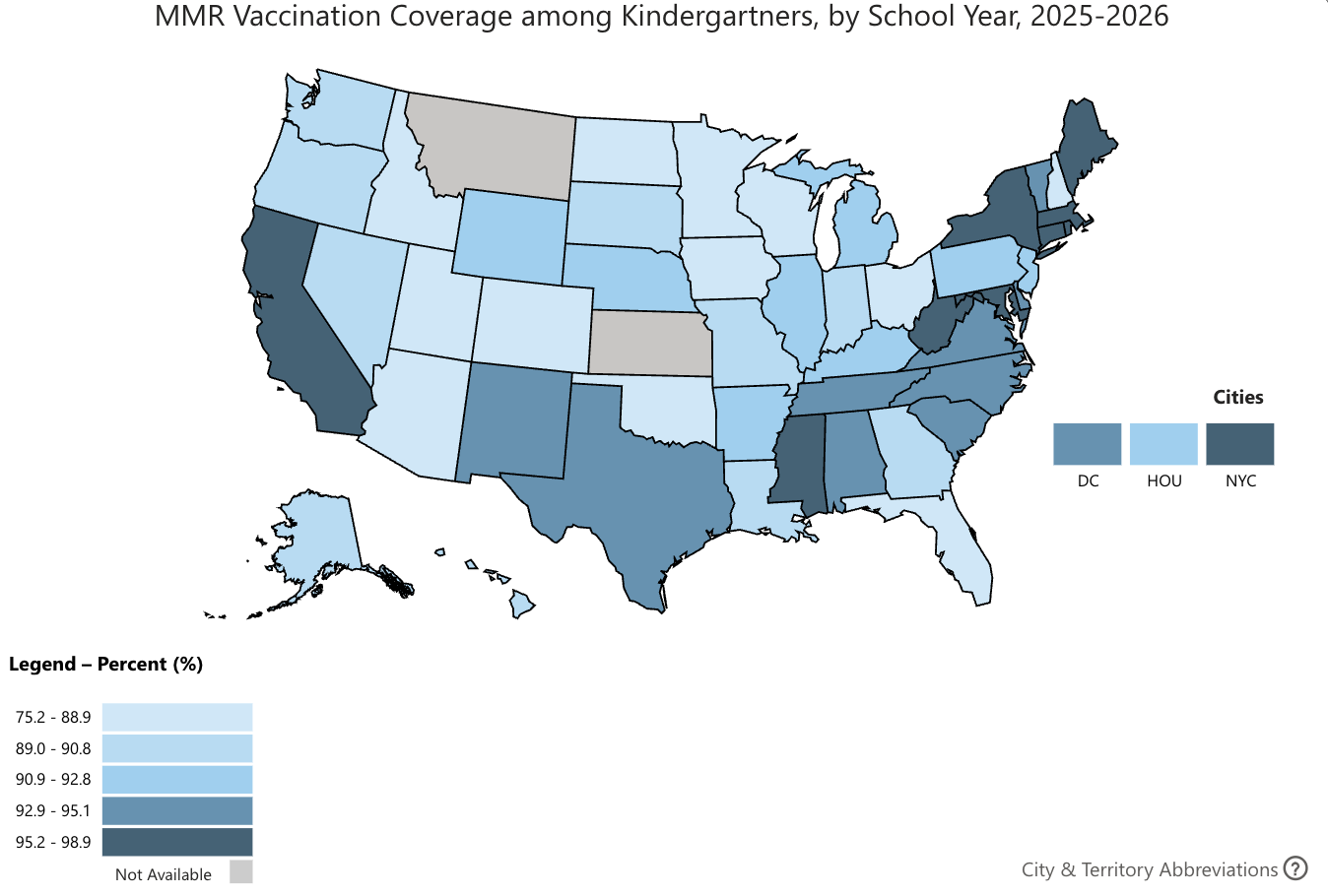
According to data recently released by CDC, 92.4% of kindergartners have received two doses against measles, mumps, and rubella. This figure is down from a 2019-2020 high of 95.2%. In some states, such as Idaho, coverage has fallen dramatically, dropping from 90% to 75% in the last decade. Falling coverage is largely attributable to an increase in non-medical exemptions, which many state legislatures have moved to loosen in recent years.
Although a month has passed since Taylor Farms recalled shredded and iceberg lettuce, the number of cyclosporiasis cases continues to rise. According to CDC data, 15,716 cases have been reported since May 1. An additional 11,841 suspected cases are under investigation. A typical year sees 3,000 to 4,000 cases reported, making this year by far the largest year on record.
Nearly every state has reported cases over the last two months. The geographic spread points to additional exposure sources. However, to date, no additional sources have been identified and investigations are ongoing by state and local health departments. According to the Food and Drug Administration, at least six clusters of unknown source have been reported since early July, including one with over 200 associated cases. The unusual number of clusters may be in part due to improved ascertainment; widespread awareness about the iceberg-linked outbreak may have increased testing that in turn revealed outbreaks that would have otherwise gone undetected.
Welcome to the twenty-seventh edition of FOI Clinical. Each week, we'll send you a briefing on outbreak news. When something urgent breaks, you'll get an alert the same day.
In this edition
Moderna mFLUSIVA approved – Cyclosporiasis – Salmonella: jalapeños – Measles – West Nile virus – Vibrio vulnificus: Louisiana – Legionnaires': Ohio nursing home – Ebola
Ages 50–64: Traditional full approval, based on clinical efficacy data from the FLUENT Phase 3 trial (~40,000 participants).
Ages 65+: Accelerated approval with a required post-licensure confirmatory trial spanning two flu seasons (FDA concern: the trial used standard-dose comparator, not high-dose/adjuvanted vaccines recommended for that age group).
Phase 3 efficacy: The trial found a 27% relative reduction in confirmed influenza illness versus standard-dose flu vaccine; 48% reduction in healthcare utilization (ED visits, hospitalizations). Reactogenicity was consistent with other mRNA vaccines, with reported symptoms including transient fatigue, myalgia, arthralgia. There were no new safety signals. Moderna expects doses available within weeks, in time for the 2026–2027 flu season.
The mRNA platform compresses vaccine manufacturing from ~6 months to 2–3 months, which addresses the strain-mismatch problem that undermines annual vaccine effectiveness when antigenic drift occurs between strain selection and distribution. The accelerated approval pathway for 65+ means this age group can begin receiving mFLUSIVA immediately, with confirmatory efficacy data required post-market.
Cyclosporiasis: Michigan fading, Ohio still climbing
The outbreak trajectory is diverging by state. Michigan's MDHHS lifted its precautionary salad advisory August 6, calling the outbreak "fading." Michigan is now reporting 12,485 cases and 279 hospitalizations as of August 6. Reported cases in Ohio continue to climb: >4,900 statewide as of August 4, with a second consecutive week of significant increases. Missouri is also heavily affected, with more than 1,000 cases reported.
Nationwide, approximately 24,300 cases have been reported (13,895 confirmed + 10,455 probable or under investigation) across 45+ states. A subset of 6,358 cases in 15 states is formally linked to the Taylor Farms de México/Taco Bell iceberg lettuce cluster. The Taylor Farms recall remains in effect (27 states). No product sample has tested positive; epidemiological and traceback evidence remains the basis for the recall.
Welcome to the twenty-sixth edition of FOI Clinical. Each week, we'll send you a briefing on outbreak news. When something urgent breaks, you'll get an alert the same day.
In this edition
Cyclosporiasis — Measles — West Nile virus — Vibrio vulnificus: Florida — Dengue: Florida + Virginia — Tularemia: Long Island — Legionnaires': New York City (closed) — Ebola
National Interest
Cyclosporiasis
On August 3, the Michigan Department of Health and Human Services announced that two Michigan residents, both of whom had serious underlying medical conditions, died "in connection with" cyclosporiasis and dehydration. These are the first confirmed deaths from cyclosporiasis ever recorded in the United States, in this outbreak or any previous one. The department said it would not release further details about the two cases.
Illnesses have now been reported in 45 states, and the CDC has called this the largest cyclosporiasis outbreak on record in the United States. A typical year sees 3,000-4,000 cases reported to the National Notifiable Disease Surveillance System.
National surveillance data through the week ending July 25 show the heaviest burden in Michigan (4,843 cases), Ohio (2,905), New York City (554), Kansas (448), and Florida (264).
Case counts reported by state and federal agencies as of early August:
Cases reported to CDC by state health departments, year to date
11,877
—
Week ending July 25
The Taylor Farms de México recall of iceberg lettuce distributed to 27 states, issued July 17, remains the only recall currently in effect. No food source has been confirmed by laboratory testing.
The CDC's July 30 update put the national total at 2,371 confirmed cases across 45 jurisdictions. That tally exceeds the total for all of 2025 (2,289) and represents the highest annual count since 1991. Recent state activity:
Pennsylvania — 202 cases and the largest active outbreak in the country. Lancaster County accounts for roughly 92 cases; 28 people have been hospitalized statewide.
Virginia — 177 cases, unchanged for a second week. Buckingham and Cumberland Counties remain under active outbreak status.
Delaware — 5 cases linked to an outbreak declared on July 22. All are adult men in Kent County, four of them unvaccinated.
The Pan American Health Organization has postponed its review of U.S. measles elimination status until November 2026. The United States will likely lose the elimination status it achieved in 2000. Canada, which is also experiencing extensive outbreaks, lost its status last year.
West Nile virus — first death outside Arizona; national cases climb
National surveillance recorded 143 confirmed human cases across 23 states as of August 4, up from 113 the week before. The count is running roughly five to nine times higher than is typical for this point in the season.
Welcome to the twenty-fifth edition of FOI Clinical. Each week, we'll send you a briefing on outbreak news. When something urgent breaks, you'll get an alert the same day.
In this edition
Cyclosporiasis – Measles – Salmonella: shell eggs – West Nile virus – Covid-19 – Leprosy: Florida – Legionnaires': New York City – Vibrio vulnificus – Ebola
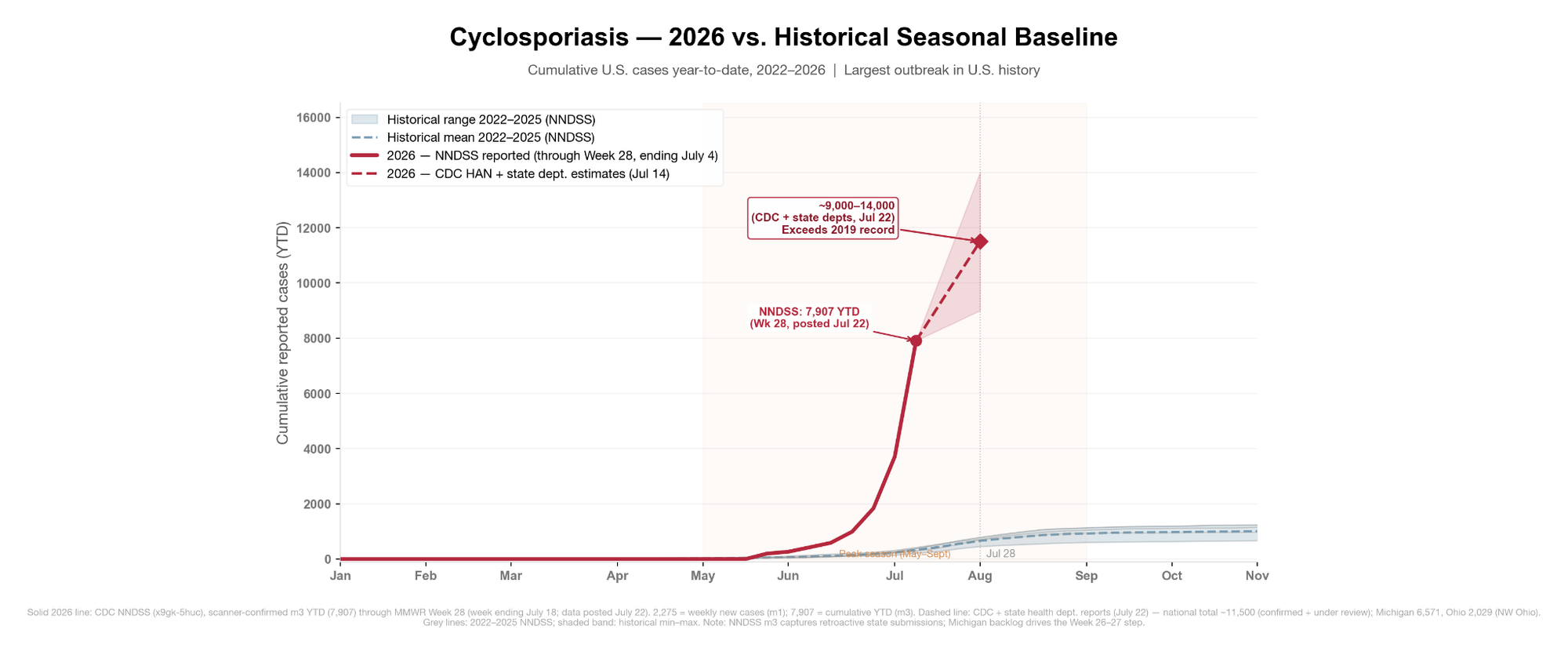
The Taylor Farms de México iceberg lettuce cluster has expanded from five to nine states (Indiana, Kentucky, Michigan, Ohio, West Virginia, plus Illinois, Kansas, Oklahoma, and Pennsylvania, added ~July 22). According to CDC, the cluster now stands at 1,947 confirmed cases and 98 hospitalizations, with zero deaths. (As a reminder, CDC reporting is delayed compared to state level reporting.) Across all domestic investigations, 4,173 lab-confirmed cases in 41 states have been reported since May 1.
State burdens as of July 27–28:
Jurisdiction
Cases
Hospitalized
As of
Michigan
9,253
160
July 27 (MDHHS)
Ohio (NW Ohio)
2,689
—
July 27
Kansas
461
12
July 29 (KDHE)
National lab confirmed, CDC
4,173
141
~July 22
NNDSS YTD
7,907
—
Week 28 (July 18)
National surveillance recorded 2,275 cases during the most recent reporting week, the highest weekly count in the past year and the first time that ceiling has been broken. Weekly counts have more than doubled in each of the last four weeks, rising from 180 → 358 → 874 → 2,275. Kansas has moved into the top five states nationally at 461 cases year-to-date, reflecting continued cluster expansion. Johnson County accounts for 143 of the state's total.
Recall status: The Taylor Farms de México voluntary recall remains in effect across 28 states covering iceberg lettuce sourced from Mexico and distributed June 29–July 16. No confirmatory positive product sample exists. FDA maintains six active cluster investigations; only Taylor Farms has a named recall.
Clinical reminders: Standard stool O&P does not detect Cyclospora. Request modified acid-fast staining or Cyclospora-specific PCR explicitly. TMP-SMX DS BID × 7–10 days. Full clinical guidance in the FOI HAN+ alert.
Measles — 35-year record
CDC updated to 2,318 confirmed cases on July 23, now in 45 jurisdictions, surpassing the 2025 full-year total (2,289) and marking the highest annual count since 1991.
Student Discount: Training in medicine or public health? FOI Clinical is available at 50% off for students and trainees. Just send a note to [email protected]. If you think your program or library should have institutional access, we'd love to hear from you.
Welcome to the twenty-fourth edition of FOI Clinical. Each week, we'll send you a briefing on outbreak news. When something urgent breaks, you'll get an alert the same day.
In this edition
Cyclosporiasis – Measles – West Nile virus – Covid-19 – Legionnaires': New York City – Grand Canyon mystery illness – New World screwworm – Ebola – Marburg: Uganda
National interest
Cyclosporiasis
The Taylor Farms de México recall is the most significant food safety development of the 2026 outbreak season. On July 17, CDC and FDA traced the multistate Midwest cluster, spanning Michigan, Ohio, West Virginia, Kentucky, and Indiana, to shredded iceberg lettuce supplied by Taylor Farms de México, a grower in central Mexico. FDA reports that 90% of interviewed cases in the five-state cluster reported eating iceberg lettuce.
Taylor Farms issued a voluntary recall on July 17 covering products distributed June 29–July 16 across 27 states, including Marketside Iceberg Salad and Shredded Lettuce sold at Walmart, as well as products distributed through Taco Bell, Jack in the Box, and Sysco. On July 18, a Taylor Farms lettuce sample not included in the recalled products tested positive. On July 19, FDA reversed course and announced the result was a false positive; FDA laboratory experts concluded the finding "does not represent true amplification." No microbiologically confirmed positive product sample exists. The recall remains in effect; FDA and CDC state that epidemiological and traceback evidence "overwhelmingly" supports iceberg lettuce as the vehicle.
The five-state cluster now has 1,644 cases and 94 hospitalizations per CDC. Reporting from individual states is substantially higher. The five-state cluster is distinct from a New York City cluster (403+ cases), which has no confirmed link to Taylor Farms and likely involves a separate produce source, consistent with NYC's historical pattern of Cyclospora outbreaks linked to raspberries and cilantro from separate importers.
State burdens as of July 20–21 (state health department sources):
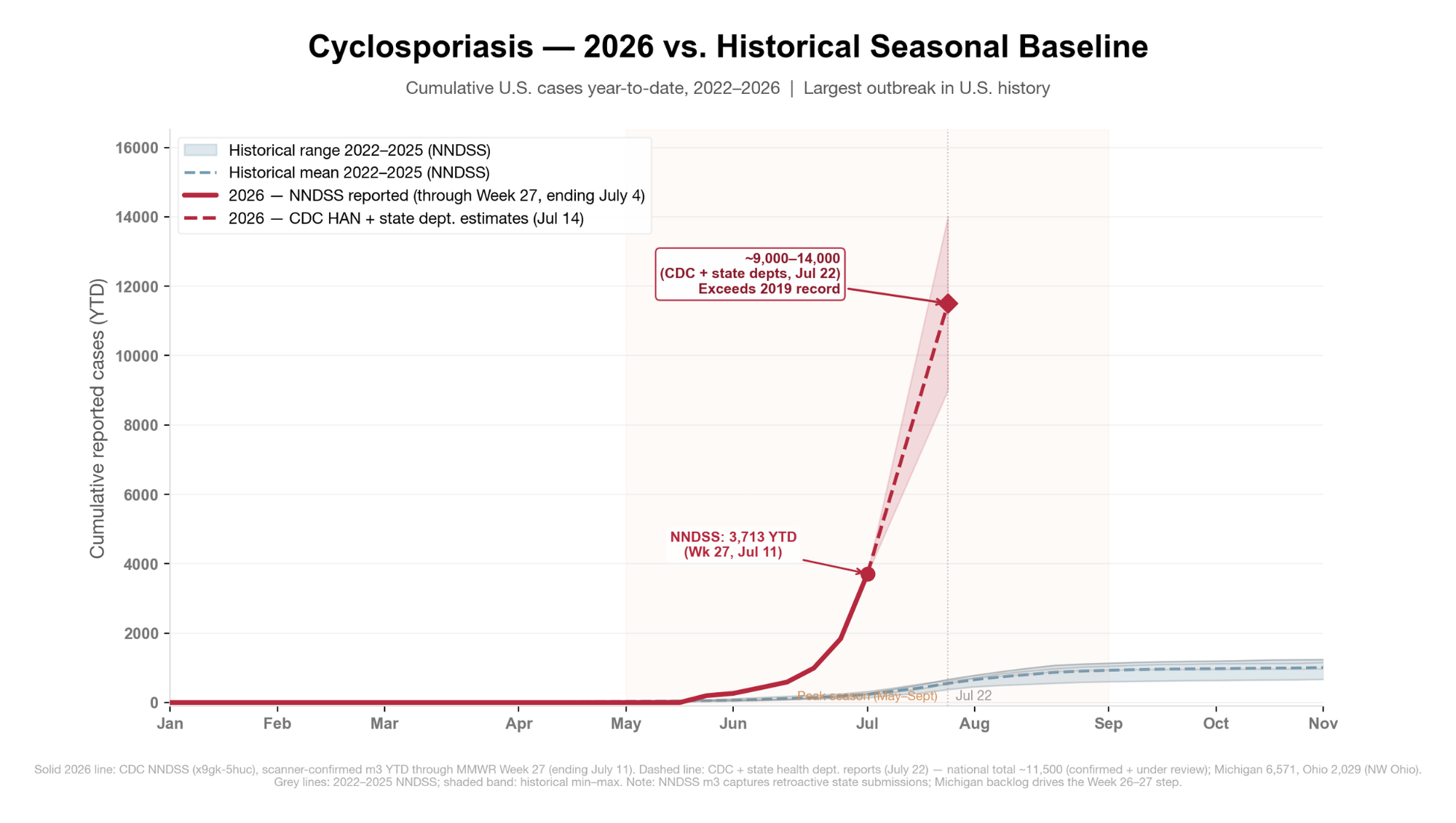
The most recent reporting week in NNDSS shows 874 cases, with year to date totals at 3,713 (2.5x prior year). The last five weeks have seen increases from 64→73→180→358→874. Thus, there is no current evidence of slowing per NNDSS data. Colorado (153 YTD) cases are predominantly travel-associated and not linked to the Taylor Farms cluster. CDC expects cases to continue rising through the end of August.
Clinical reminders: Standard stool O&P does not detect Cyclospora; request modified acid-fast staining or Cyclospora-specific PCR explicitly. TMP-SMX DS BID × 7–10 days remains the only reliably effective treatment. Full clinical guidance is available in the FOI HAN alert.
Measles
CDC updated this year's running total to 2,260 confirmed cases on July 16 across 44 jurisdictions. Independent trackers put the total slightly higher at 2,295, which surpasses the 2025 total and makes this the largest year in 35 years.
Welcome to the twenty-third edition of FOI Clinical. Each week, we'll send you a briefing on outbreak news. When something urgent breaks, you'll get an alert the same day.
In this edition
Cyclosporiasis – Measles – West Nile virus – E. coli: Publix blueberries – Infant botulism update – Legionnaires': New York City – Salmonella: Shinnecock Nation – Chagas disease: California – Ebola – Marburg
National interest
Cyclosporiasis: largest U.S. outbreak on record
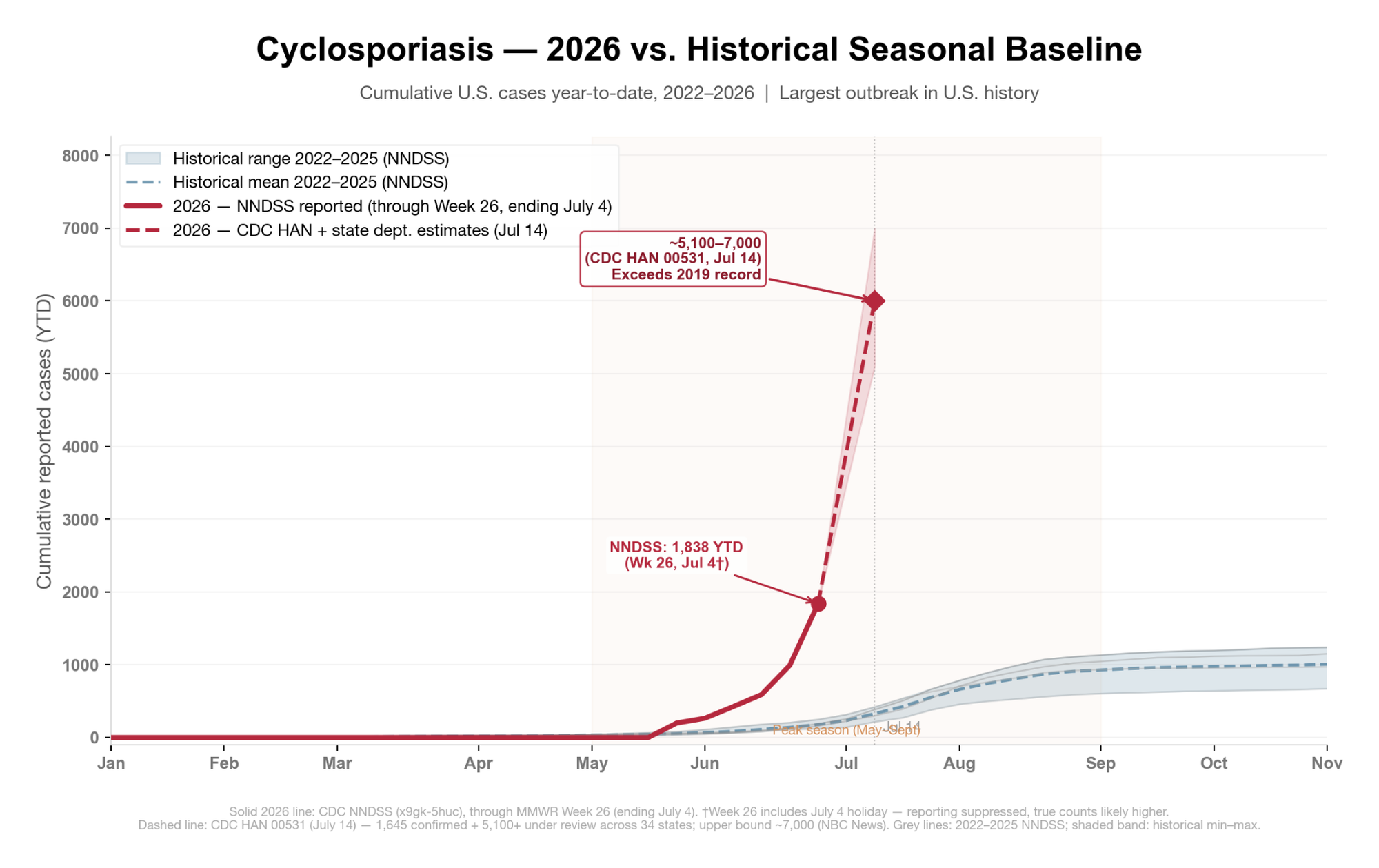
On July 14, the Centers for Disease Control and Prevention issued a Health Alert (CDC HAN 00531) with data suggesting 2026 could become the largest cyclosporiasis year on record, surpassing 2019's peak of approximately 4,700 cases.
As of July 14, there have been 1,645 confirmed cases across 34 states, plus 5,100+ additional cases under review, approaching 7,000 when combined. To date, there have been at least 141 hospitalizations (9%) and zero deaths.
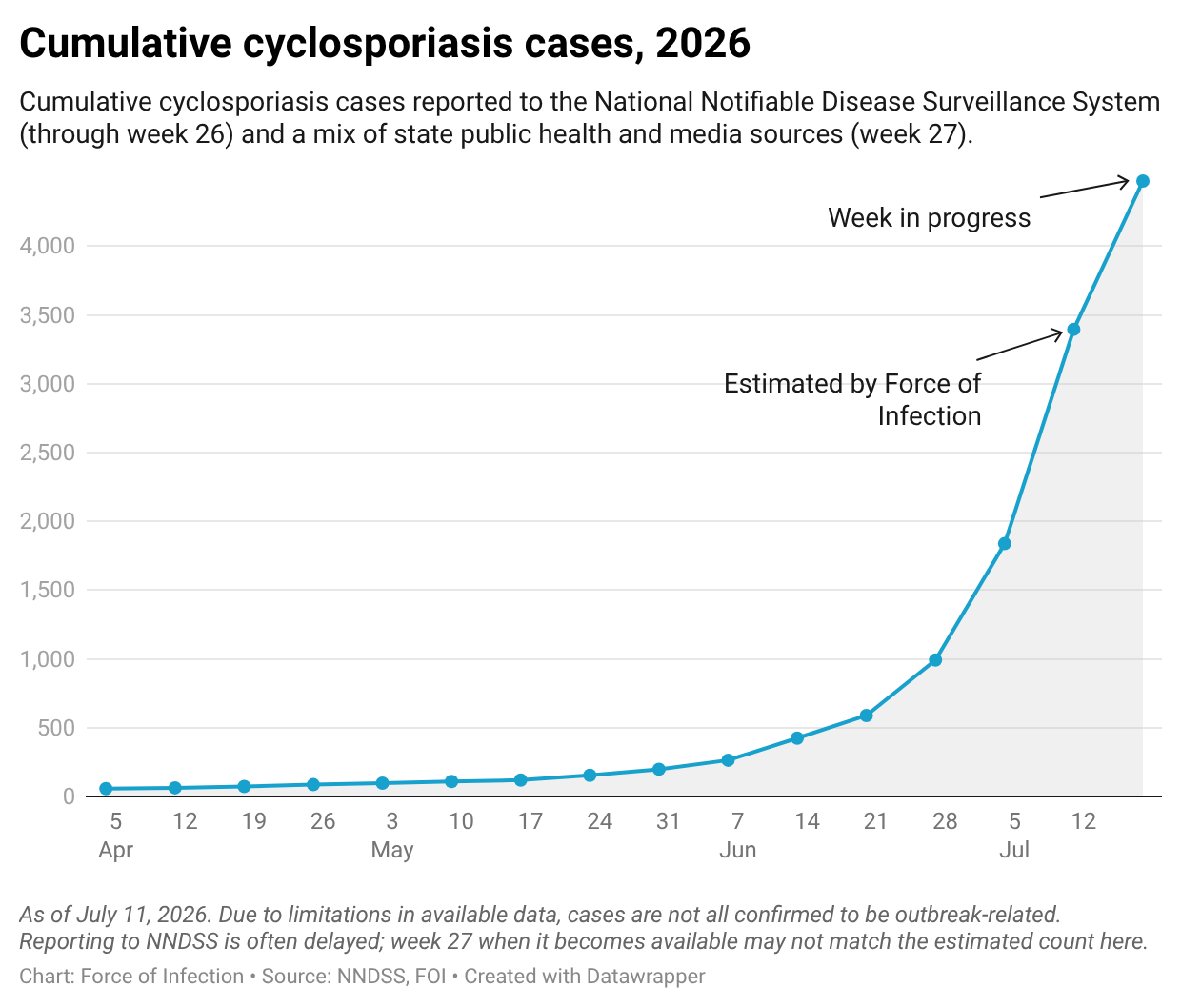
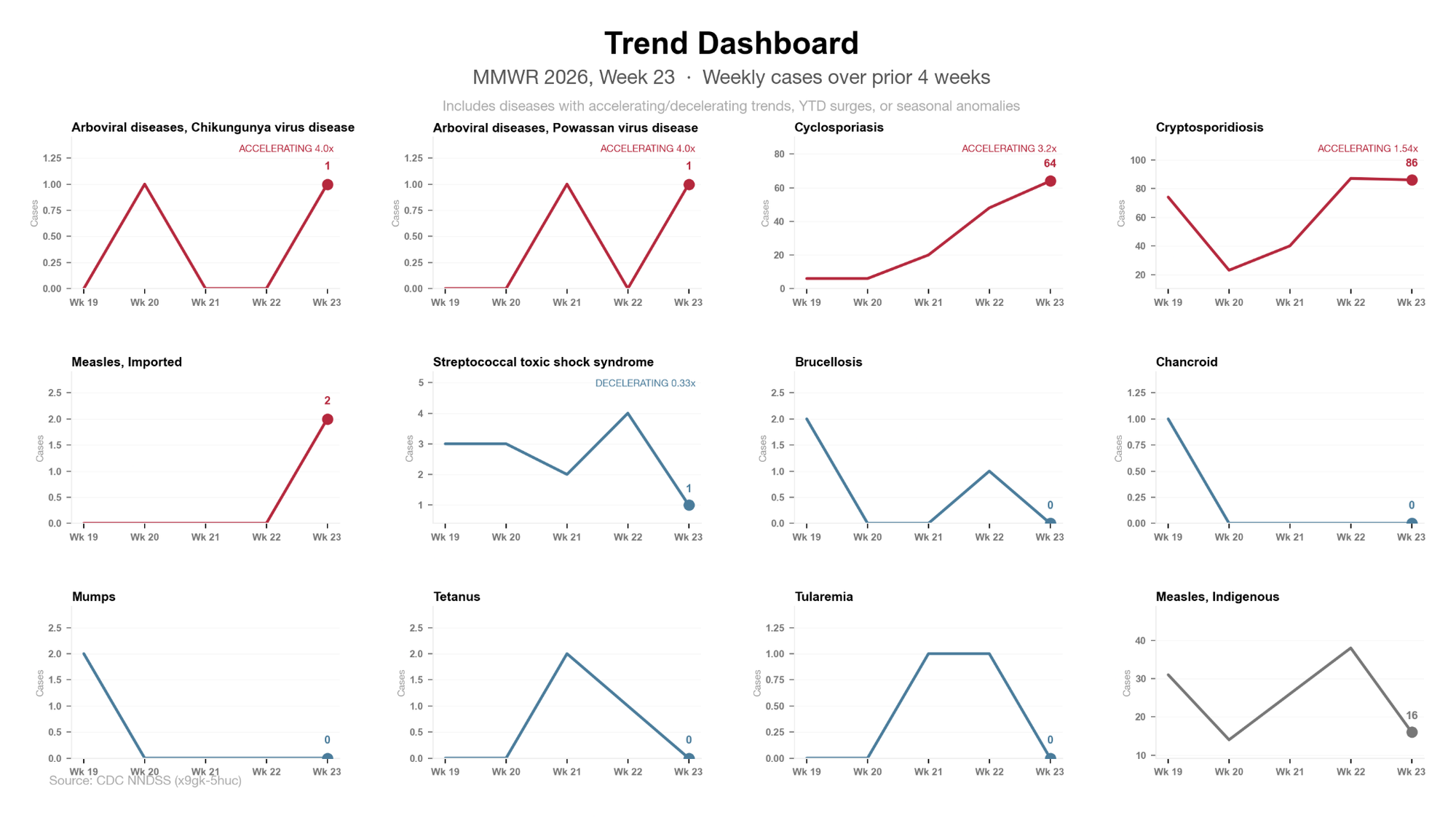
Data from the Nationally Notifiable Disease Surveillance System shows 358 cases reported in the most recent week, with a year-to-date cumulative total of 1,838. The four-week trajectory confirms rapid acceleration, rising from 64 to 73, then jumping to 180 and 358. The full state-level burden is substantially higher; Michigan alone reported 700 cases on July 1, climbing to 3,762 by July 15.
Michigan (3,762 cases across 56 counties; 44 hospitalizations as of July 9) leads with the most cases. Michigan, as well as Ohio (397, 57 counties), West Virginia (statewide outbreak declared, 47 cases reported), and Kentucky (~100 cases) share a confirmed epidemiological link per the CDC's health alert. New York (517 statewide), North Carolina (307), and Illinois (216) are also among the states reporting elevated counts.
No food source has been confirmed and no recall has been issued. However, Michigan officials have named lettuce and salad greens as the leading hypothesis, following more than 1,000 patient interviews. Two epidemic curve peaks have been detected (~June 25 and ~July 7), suggesting possible multiple contamination sources or lots. Taco Bell voluntarily pulled select items (lettuce, cilantro, onion, pico de gallo, guacamole) in some locations; CDC and FDA have not confirmed a link.
Measles
Measles cases are outpacing 2025 levels. CDC updated this year's total to 2,231 confirmed cases as of July 9, just 58 cases short of the 2025 full-year total (2,289) with five months remaining.
State updates:
Virginia: 177 cases, with no new cases reported since July 4. 169 of 177 cases are in unvaccinated individuals; 9 hospitalized, no deaths. Buckingham County (126), Cumberland County (17), and Prince Edward County (11) account for the core outbreak; additional cases are distributed across other localities.
Iowa: First 2026 case added, in a Polk County adult.
West Nile virus
2026 has the worst early-season start in more than 20 years. As of July 14, 81 confirmed human cases were reported across 18 states, with 57 (70%) neuroinvasive.
This information is made available as a public service. To support our work and receive weekly updates on outbreak-prone disease activity, consider upgrading. We also have a general-reader publication, Force of Infection.
Tracking cyclosporiasis is more difficult than tracking some infectious diseases, because standard GI workups do not routinely include testing for cyclosporiasis. Typically, providers must suspect the diagnosis to order testing. This creates a detection bias that distorts surveillance, because it is sensitive to clinician awareness.
Michigan, for example, has a much higher number of cyclosporiasis cases at 2,640 than the second-most affected state, New York (470). This fivefold difference does not necessarily reflect a true difference in disease burden. A more likely explanation is that awareness of the outbreak is higher in Michigan which is driving a feedback loop. More awareness prompts more testing which leads to more detection and reporting.
This information is made available as a public service. To support our work and receive weekly updates on outbreak-prone disease activity, consider upgrading. We also have a general-reader publication, Force of Infection.
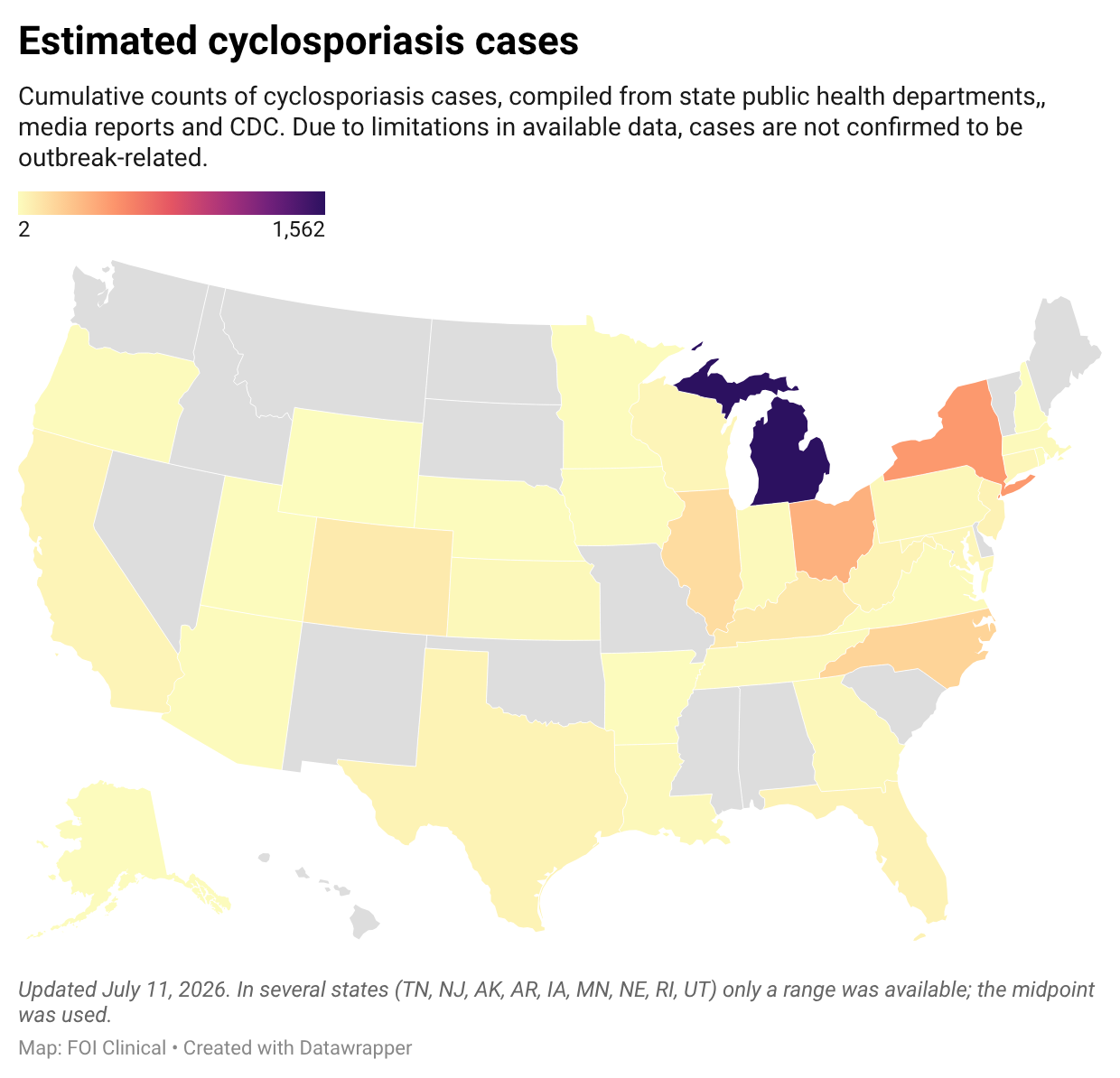
According to state-level estimates compiled by FOI Clinical, cumulative cyclosporiasis reports now exceed 3,300 nationwide (year-to-date, not confirmed outbreak-related). For context, a typical year sees 3,000 to 4,000 cyclosporiasis cases reported to the National Notifiable Disease Surveillance System. No source has been identified yet.
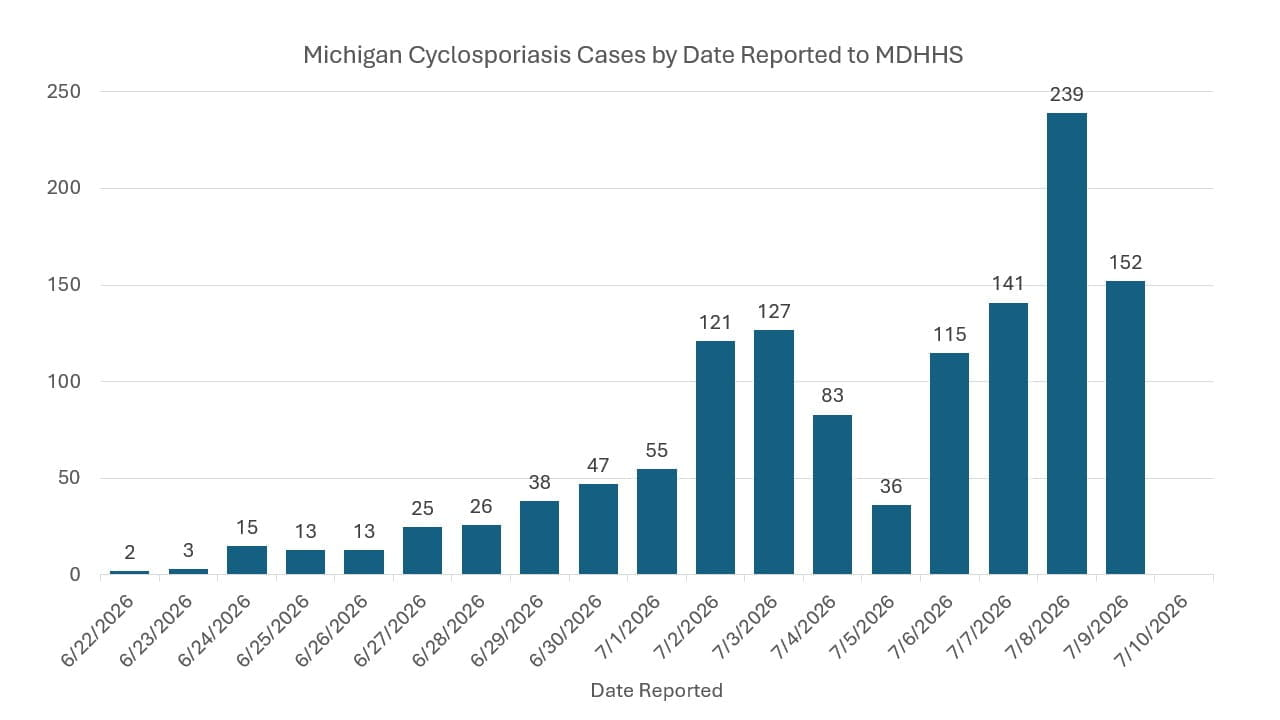
Michigan remains most affected at 1,562, followed by New York (470) and Ohio (364). At least 500 additional cases have been reported in the last day, including more than 300 in Michigan. Data from the Michigan Department of Health & Human Services show that outbreak signals began in late June and have accelerated steadily since.
Alert: Cyclospora cayetanensis: Multistate Outbreak with Midwest Epicenter
FOI Clinical issues two types of rapid communications: alerts for highest priority information, and advisories for emerging events clinicians should be aware of. This is an alert.
A rapidly expanding multistate Cyclospora cayetanensis outbreak has its epicenter in southeast Michigan and northwest Ohio, according to current reports. As of July 8, Michigan has received more than 700 reports of cyclosporiasis, including 38 hospitalizations since June 22. This is approximately 14 times the state's annual average. Ohio reports 177 cases across 43 counties (last updated July 7, per ODH spokesperson), with spread throughout central and northwest Ohio.
The effects extend beyond the Midwest. At least 18 states are affected nationally; aggregated state-level reporting suggests a true national burden well above 1,200
Welcome to the twenty-second edition of FOI Clinical. Each week, we'll send you a briefing on outbreak news. When something urgent breaks, you'll get an alert the same day.
In this edition
Tularemia – Measles – Brucellosis: California – Mumps: Maryland – Malaria: Maryland – Legionnaires: NYC – Grand Canyon unknown – Powassan: New England – Plague rule out – Ebola – Marburg – Measles in the Americas
National interest
Tularemia
Peak season is underway; 78% of annual U.S. tularemia cases occur between May and September. Reports this year are lower than during the same period last year, with 38 cases reported vs. 95 prior year (0.4x). The below-baseline count may partly reflect a January 2026 case definition revision (CSTE 25-ID-09) that tightened probable case criteria.
Post-exposure prophylaxis: shortened from 14 to 7 days (cipro or levofloxacin)
Streptomycin demoted to third-tier; β-lactams and macrolides are ineffective
Scalp examination is essential. Scalp ulcers are easily missed in febrile patients with cervical adenopathy and outdoor exposure
Francisella tularensis is a Tier 1 Select Agent with an infectious dose of <10 organisms by inhalation.
Measles
CDC updated to 2,170 confirmed cases on July 2, up 36 from last week, across 41 jurisdictions. The 2026 year to date total is now 119 cases short of matching all of 2025 (2,289 full-year) with five months remaining. The PAHO review to make a determination on the U.S.'s elimination status convenes in November.
State updates:
Utah: 704 total (507 in 2026), up 5 since last week.
Virginia: 167 cases. Up 26 since the June 30 count. Buckingham and Cumberland County outbreak ongoing. The June 17 Dulles Airport exposure monitoring window closed July 8 with no confirmed secondary cases.
Texas: 182 cases. Unchanged since June 24, centered in Hudspeth County federal detention facilities.
Regional interest
Brucellosis: California
California accounts for 16 of 37 national brucellosis cases year to date (43%), well above its historical ~21% share. LA County DPH announced a South Los Angeles County cluster of Brucella melitensis infections on May 23, linked to unpasteurized cheese imported from Mexico. No brand has been publicly named and no recall has been issued.
B. melitensis, responsible for 57% of CDC-tested U.S. isolates, is almost exclusively associated with small ruminant dairy (goat, sheep). Mexico accounts for 58% of travel-linked U.S. brucellosis cases. Clinicians in Southern California should ask about raw dairy consumption in patients presenting with undulant fever, arthralgia, or unexplained hepatitis.
Mumps: Maryland
Maryland accounts for 49 of 122 national mumps cases to date (40.2%), concentrated in Baltimore City and surrounding counties (Anne Arundel, Baltimore County, Carroll, Harford, Howard, Queen Anne's). The cluster has been active since February 2026, when the Maryland Department of Health (MDH) announced 26 cases, six times the full-year 2025 total, and has grown steadily since with no common exposure identified.
Welcome to the twenty-first edition of FOI Clinical. Each week, we'll send you a briefing on outbreak news. When something urgent breaks, you'll get an alert the same day.
In this edition
Infant botulism: Nara Organics – Cyclosporiasis – Measles – Mpox – Powassan virus: New England – Plague: Arizona – Ebola – Nipah: India – Measles: Americas/World Cup – Notable declines
National interest
Infant botulism: Nara Organics recall
The FDA and CDC are investigating a multistate infant botulism outbreak involving three confirmed cases in California, Pennsylvania, and Washington, all male infants aged 2–5 months, illness onset April–May 2026, all hospitalized, no deaths. All three consumed Nara Organics Whole Milk Organic Powdered Infant Formula; toxin type A was identified in each. Nara Organics recalled all infant formula on June 13 based on epidemiological evidence, before laboratory contamination was confirmed. No new cases have been added since the initial notice.
The critical finding in the June 26 update: traceback identified Organic West Milk as the raw milk supplier and Dairy Farmers of America as the spray-drying processor, the identical supply chain implicated in the November 2025 ByHeart infant formula botulism outbreak (28 confirmed, 20 probable cases across 19 states; declared over March 4, 2026). Organic West Milk had provided an incomplete customer list during the 2025 investigation that omitted Nara Organics, raising concern that additional exposed brands may remain unidentified. The formula manufacturer is Milchwerke Mittelelbe GmbH (Elb-Milch, Germany); FDA has inspected both European production facilities and issued deficiency observations. An additional suspected toxin type A case in an infant in Puerto Rico is under investigation.
This is the second product-associated infant botulism outbreak within eight months involving overlapping supply chain actors, a pattern suggesting a persistent contamination point at the raw milk or spray-drying stage rather than an isolated manufacturing event. Environmental confirmation from product testing is still pending.
Cyclosporiasis
An active Cyclospora cayetanensis outbreak is generating significant national attention. The CDC line list reports 145 domestically acquired cases across 17–20 states (last updated June 16), with illness onset May 1–June 7, 20 hospitalizations, and no deaths. During the most recent reporting week, the National Notifiable Disease Surveillance System saw 73 cases reported in a single week putting year to date totals at 589 cases (1.2x prior year). The outbreak is running well past the typical early-season acceleration.
Welcome to the twentieth edition of FOI Clinical. Each week, we'll send you a briefing on outbreak news. When something urgent breaks, you'll get an alert the same day.
During the most recent reporting week, 64 cases were reported to the National Notifiable Disease Surveillance System, up from 48 the week prior and 20 two weeks ago. Year to date, 424 cases have been reported (1.3x prior year). The FDA is still investigating an active outbreak with an unknown food source. We covered the early acceleration in Issue 19.
Measles
CDC reports 2,104 confirmed cases as of June 18, up 31 in one week, across 41 jurisdictions (Connecticut added).
State dashboard updates:
Connecticut: First case of 2026. An unvaccinated Hartford County adult with recent international travel, hospitalized in stable condition.
Utah: 687 total (490 in 2026), 13 cases in the last 3 weeks. Stalling continues. Updated June 16.
Virginia: 129 cases, up 19 in one week. Buckingham County outbreak continues. Updated June 23.
Mpox
Year to date, 640 cases have been reported (1.3x prior year). CDC's situation summary (updated June 1) notes >20 laboratory-confirmed clade I cases in the U.S. since November 2024, all linked to travel. Several Western European countries are now reporting clade Ib cases with no documented travel history, indicating local sexual transmission. Clade II remains at low levels but fall 2025 marked the highest monthly counts since 2022.
During Pride Month, several cities expanded mpox vaccination access in response to rising case counts. Boston's public health commission flagged an uptick in cases citywide and nationally, offering walk-up JYNNEOS doses at Pride events and scheduling additional clinics through the summer. The push comes after the CDC in late May removed its "Safer Sex, Social Gatherings, and Monkeypox" webpage, the primary federal guidance on reducing mpox risk at Pride events, sex clubs, and high-contact settings, despite a July 2025 federal court order requiring restoration of removed LGBTQ+ health information.
Advisory: Bundibugyo ebolavirus outbreak and hantavirus update
FOI Clinical issues two types of rapid communications: alerts for highest priority information, and advisories for emerging events that clinicians should be aware of. This is an advisory.
The causative agent is Bundibugyo ebolavirus (BDBV), first identified in Uganda in 2007. This is the critical distinction from recent outbreaks: there is no approved vaccine or therapeutic for BDBV. Existing vaccines (Ervebo) and monoclonal antibodies (Ebanga, Inmazeb) target the Zaire species and are not thought to be effective.
Scale and spread
The earliest suspected case was in a healthcare worker in Bunia who developed symptoms on April 24 and died three days later. The outbreak now spans 9 health zones in Ituri Province, with U.S. CDC reporting 675 suspected, probable and confirmed cases and 134 deaths, as of May 19. Case counts have grown very rapidly over the last few days, as health officials work to determine the true scope of the outbreak.
The outbreak has spread beyond Ituri: confirmed cases have appeared in Gomaand Kinshasa, and 2 confirmed cases (1 death) in Uganda, travelers from DRC in Kampala with no apparent epidemiological link to each other. Both had a travel history to the affected area.
Advisory: Andes Hantavirus – MV Hondius Cruise Ship Outbreak
As of May 7, 2026
Situation Summary
An outbreak of Andes hantavirus (Orthohantavirus andesense) is underway aboard the MV Hondius, a Dutch-flagged expedition cruise ship that departed Ushuaia, Argentina on April 1, 2026. As of May 7, there are 8 reported cases (5 laboratory-confirmed, 3 suspected), including 3 deaths. The virus has been confirmed as the Andes strain, the only hantavirus known to transmit person to person, by South Africa's National Institute for Communicable Diseases and Geneva University Hospitals.
The MV Hondius carried 147 people (88 passengers, 59 crew) of 23 nationalities, including 17 Americans. The ship is currently en route to Tenerife, Canary Islands, where it is expected to dock on May 11. Upon arrival, non-Spanish passengers will be repatriated; 14 Spanish nationals will be quarantined at a military hospital in Madrid.
A Swiss passenger who had disembarked and returned home was confirmed positive at University Hospital Zurich.
Several other reports are being investigated. Two Singaporean passengers (men in their 60s) are isolated at Singapore's National Centre for Infectious Diseases; one has a runny nose, the other is asymptomatic. A KLM flight attendant in the Netherlands has been hospitalized at Amsterdam UMC with mild symptoms who reportedly had contact with an infected passenger has been ruled out, according to Inside Medicine.
WHO assesses the global risk as low. WHO Director-General Tedros Ghebreyesus has stated that more cases may emerge in the coming weeks due to the virus's long incubation period (up to 8 weeks), but confirmed on May 7 that no additional passengers beyond the identified cases have reported symptoms. WHO has deployed an expert on board for a comprehensive medical assessment and arranged shipment of 2,500 diagnostic kits from Argentina to laboratories in five countries.
Origin
One hypothesis is that the Dutch couple who became the first two cases contracted the virus before boarding, during a bird-watching trip through Argentina, Chile, and Uruguay that included sites where the long-tailed pygmy rice rat (Oligoryzomys longicaudatus), the natural reservoir for Andes virus, is present.
Confirmed Case Summary
This table reflects publicly available details about reported cases, to the best of our knowledge. This information should be considered preliminary.
#
Nationality
Status
Key details
1
Dutch, M, 70
Suspected; died (April 11)
Died on board; probable index case. Death initially attributed to natural causes; posthumous confirmation pending.
2
Dutch, F, 69
Confirmed; died (April 26)
Wife of case 1; flew from Saint Helena to Johannesburg on April 25; briefly boarded KLM Flight 592 but was removed before departure due to deteriorating condition; died at hospital the following day. Confirmed by NICD South Africa (PCR, May 4).
3
German, F
Suspected; died (May 2)
Died on board; developed fever on April 28 and presented with pneumonia. Cause of death under investigation.
4
British, M
Confirmed; critical
Evacuated from Ascension Island to South Africa on April 27. Confirmed by NICD South Africa. Transferred to Leiden University Medical Center (Netherlands).
Evacuated to Dusseldorf, Germany; reported not showing symptoms but evacuated due to close contact with case 3. Has since returned to Germany.
8
Swiss, M
Confirmed
Disembarked before outbreak recognized; confirmed Andes strain at University Hospital Zurich via Geneva HUG reference lab.
Illness onset ranged from April 6 to April 28. Clinical presentation has included fever, gastrointestinal symptoms, and rapid progression to pneumonia, acute respiratory distress syndrome (ARDS), and shock.
U.S. Passengers
The CDC stated on May 6 that "the risk to the American public is extremely low.” Former passengers are being monitored in at least three states:
The 2025–2026 RSV season in the United States has followed an atypical trajectory. Elevated RSV activity did not begin until December 2025, and the season peaked in late February 2026, roughly 8 weeks later than the 2023–24 season. Peak hospitalization rates were lower than either of the two preceding seasons. As of late March 2026, RSV activity is declining nationally but remains elevated in several regions, particularly the Mountain West.
In response to the prolonged season, 48 of 66 federally funded immunization programs have extended nirsevimab (Beyfortus) eligibility through April 30, 2026.
Disease severity among hospitalized patients has been comparable to recent seasons. The shift is in timing, not in clinical presentation.
Student Discount: Training in medicine or public health? FOI Clinical is available at 50% off for students and trainees. Just send a note to [email protected]. If you think your program or library should have institutional access, we'd love to hear from you.
Welcome to the eighth edition of FOI Clinical. Each week, I'll send you a briefing on outbreak news. When something urgent breaks, you'll get an alert the same day.
In this edition
Measles - Mumps - Haemophilus influenzae - Tularemia in CA - Tetanus in CA - Hepatitis A in Italy
National interest
Measles
As of March 27, 2026, there have been 1,575 cases, up 88 from last week. The largest case totals continue to be in South Carolina, Utah, Florida, and Texas.
The rate of new cases has dwindled, with the South Carolina outbreak effectively over, and the outbreak in Florida slowed. However, this is not
Welcome to the seventh edition of FOI Clinical. Each week, I'll send you a briefing on outbreak news. When something urgent breaks, you'll get an alert the same day.
In this edition
Measles - Seasonal respiratory illness update - Mpox in Missouri - Hantavirus pulmonary syndrome in New York - Leptospirosis in Ohio, territories - Meningitis in the UK
National interest
Measles
As of March 19, 2026, there have been 1,487 confirmed cases of measles this year. Thirty-two states have reported cases. The largest case totals are in South Carolina, Utah, Florida, and Texas.
Several notable outbreaks are underway. The list below is not comprehensive, but rather a selection of prominent active clusters worth keeping in mind.
South Carolina: As of March 24, there have been 997 confirmed cases in a multi-county outbreak. There have been no new cases reported since the last edition of FOI Clinical.
Arizona/Utah: The outbreak in Utah is growing quickly. There have been 486 confirmed cases, an increase of 38 from last week. All local health departments in the state have reported cases, with the majority of cases reported in Southwest Utah (n = 233), Utah County (n = 78), Salt Lake County (n = 53), and Central Utah (n = 36). The virus is present in wastewater samples around the state, confirming active community spread. Exposed locations are listed here. The outbreak in Arizona is growing more slowly; there have been 2 new cases reported in the last week, raising the total for the outbreak to 280.
Welcome to the sixth edition of FOI Clinical. Each week, I'll send you a briefing on outbreak news. When something urgent breaks, you'll get an alert the same day.
In this edition
Measles - Seasonal Respiratory Infections - Interim Flu VE - Expanded RSV Vax Approval - Hantavirus in New Mexico - Infant Formula Recall Outside US - Meningitis in the UK
National interest
Measles
As of March 12, 2026, there have been 1,362 confirmed cases of measles this year, up 81 from the week prior. Thirty-one states have reported cases. The largest case totals are in South Carolina, Utah, Florida, and Texas.
Several notable outbreaks are underway. The list below is not comprehensive, but rather a selection of prominent active clusters worth keeping in mind.
South Carolina: The multi-county outbreak in South Carolina has 997 confirmed cases to date. The outbreak has slowed considerably, with 7 new cases confirmed in the past two weeks.
Arizona/Utah: The apparent slowdown over the past couple of weeks was a mirage. Cases have shot up in Utah, with more cases reported during the last week in February (44) than in any prior week in the outbreak (data reporting is a few weeks delayed for the state). This brings the total for 2026 to 209 and the outbreak total to 405, meaning more cases have now been reported this year than last year. More than 150 people (nearly 40%) have gone to the emergency department for measles during this outbreak, according to the state's epidemiologist. Exposed locations are listed here. Increasing vaccination rates is proving challenging, particularly in the heavily-affected southwestern part of the state. In contrast, Arizona has not reported any new cases in March, and the total remains at 276 for the outbreak.
Welcome to the fifth edition of FOI Clinical. Each week, I'll send you a briefing on outbreak news. When something urgent breaks, you'll get an alert the same day.
As of March 5, 2026, there have been 1,281 confirmed cases, up 145 from the week prior. 31 states have reported cases so far this year. The largest case totals have been reported in South Carolina, Utah, Florida, and Texas.
Updates on Hotspots
Several notable outbreaks are underway. The list below is not comprehensive, but rather a selection of prominent active clusters worth keeping in mind.
Seasonal Vaccine Effectiveness: What the Data Shows
Flu, Covid-19, and RSV vaccine effectiveness data for this season is starting to come in. FOI Clinical has pulled out the key numbers you need for patient counseling and end-of-season decision-making. These numbers can help you set realistic expectations with patients and answer the question, "did my flu shot even work?"
So far, effectiveness looks similar to a typical year, even with the emergence of the new H3N2 subclade K. As always, effectiveness depends on how well circulating strains match the vaccine composition.
Influenza
This season, adults: Canadian researchers estimated how well this season's flu vaccine is working against H3N2, the dominant flu strain circulating this season. Using data from four provinces, they found the vaccine reduced the risk of a doctor visit for H3N2 flu by roughly 40%. Like the United States, Canada predominantly uses egg-based vaccines.
Alert: Extensively Drug-Resistant Salmonella Linked to Moringa Powder Capsules
The Centers for Disease Control and Prevention (CDC) is investigating a multistate outbreak of extensively drug-resistant Salmonella infections linked to Rosabella brand moringa powder capsules distributed by Ambrosia Brands, LLC.
Seven cases have been reported across seven states, with three hospitalizations and no deaths as of February 13. The outbreak strain is resistant to all first-line and alternative antibiotics commonly recommended for Salmonella, and carries an NDM-1 carbapenemase gene, meaning it may also be resistant to carbapenems. According to CDC, this is the first documented outbreak of Salmonella with an NDM-1 gene in the United States.
The capsules are sold in white plastic bottles with a green label, covering 52 lot codes with 2027 expiration dates. The product was available nationwide primarily through the company's website, Amazon, TikTok Shop, Shein, and eBay. The firm has agreed to a voluntary recall. Specific lot codes are available
FOI Clinical is a resource from the team behind Force of Infection, trusted by 47,000 readers for flu, Covid-19, RSV, and norovirus tracking.
We track outbreaks and disease activity, then send you detailed reports on what's relevant to your practice.
Our track record
Our parent publication, Force of Infection has run continuously since 2022, with readers in all 50 states and an 85% annual retention rate, which is far above the industry average for newsletters.
FOI Clinical was launched in February 2026 to extend coverage to outbreak-prone diseases, with an eye toward providing useful information to clinicians. In a survey, 96% of FOI Clinical survey respondents reported that the reports were useful. FOI Clinical has been featured in Medscape and NPR.
During two protracted government shutdowns, federal agencies stopped releasing surveillance data, so we went to all 50 state health department websites and collected the